

What a Journey contains
Every Journey has the same six parts. The diagram shows them from the entry point at the top to the goals at the bottom.Entry points and the Default Journey
The entry point decides which Journey a shopper is in. Most entry points are pages, such as the home page, collection pages, or every product page. Some add a condition, such as “user is logged in”.- Selection. Crossword checks the shopper’s page and context against every Journey’s entry point and applies the one that matches. When the shopper moves to another page, Crossword checks again.
- Specificity. When entry points overlap, the more specific one wins. A Journey for one product’s page wins over a Journey for every product page.
- Fallback. The Default Journey covers any page no other Journey claims. Every shopper is always in exactly one Journey, so there are always starters to tap and an Agent to answer.
Starters and proactive messages route to Agents
Everything a Journey shows leads to an Agent, and the Journey card names that Agent next to each item.- Conversation starters belong to the Journey. The shopper sees them whenever the Journey applies. Tapping one sends it straight to the Agent named next to it. A starter can also open a component, such as the quiz.
- Proactive messages each carry their own “shows when” rule, such as 30 seconds on the page, a scroll to the reviews, a paid ad as the arrival source, or a past order. The message shows when its rule is met inside the active Journey. A reply goes straight to the Agent named next to it. Read Rules for what a “shows when” rule can test.
- Typed questions do not use the Journey’s routing. They go through intent routing, set in Global settings, which sends each question to the right Agent.
Goals
Each Journey names one primary and one secondary goal. The primary goal is the outcome the Journey exists for. The secondary goal is the next best result when the primary one does not happen.
Each Journey’s goals become its success metric. Read Quality and governance for how those metrics roll up.
How it fits
A Journey lives inside an experience, next to the settings and Agents it uses.- Agents answer inside a Journey. The Journey names its Agent, and each starter and proactive message names the Agent it routes to.
- Global settings hold what every Journey shares: the welcome message, intent routing for typed questions, brand voice, and global guardrails.
- Quality and governance measures each Journey against its goals, and tests every Journey before it goes live.
- Rules is the reference for entry points and “shows when” rules.
- Campaigns handle what happens over time. Read Journeys vs campaigns to choose between them.
Example
The Product Q&A Journey from a gummy supplement store’s board, written out as one Journey card.%Product Name% and %Ad Angle% are filled in when the message shows.
The board below plans the whole store as Journeys and Agents. Each Journey column follows the same shape as the card above.
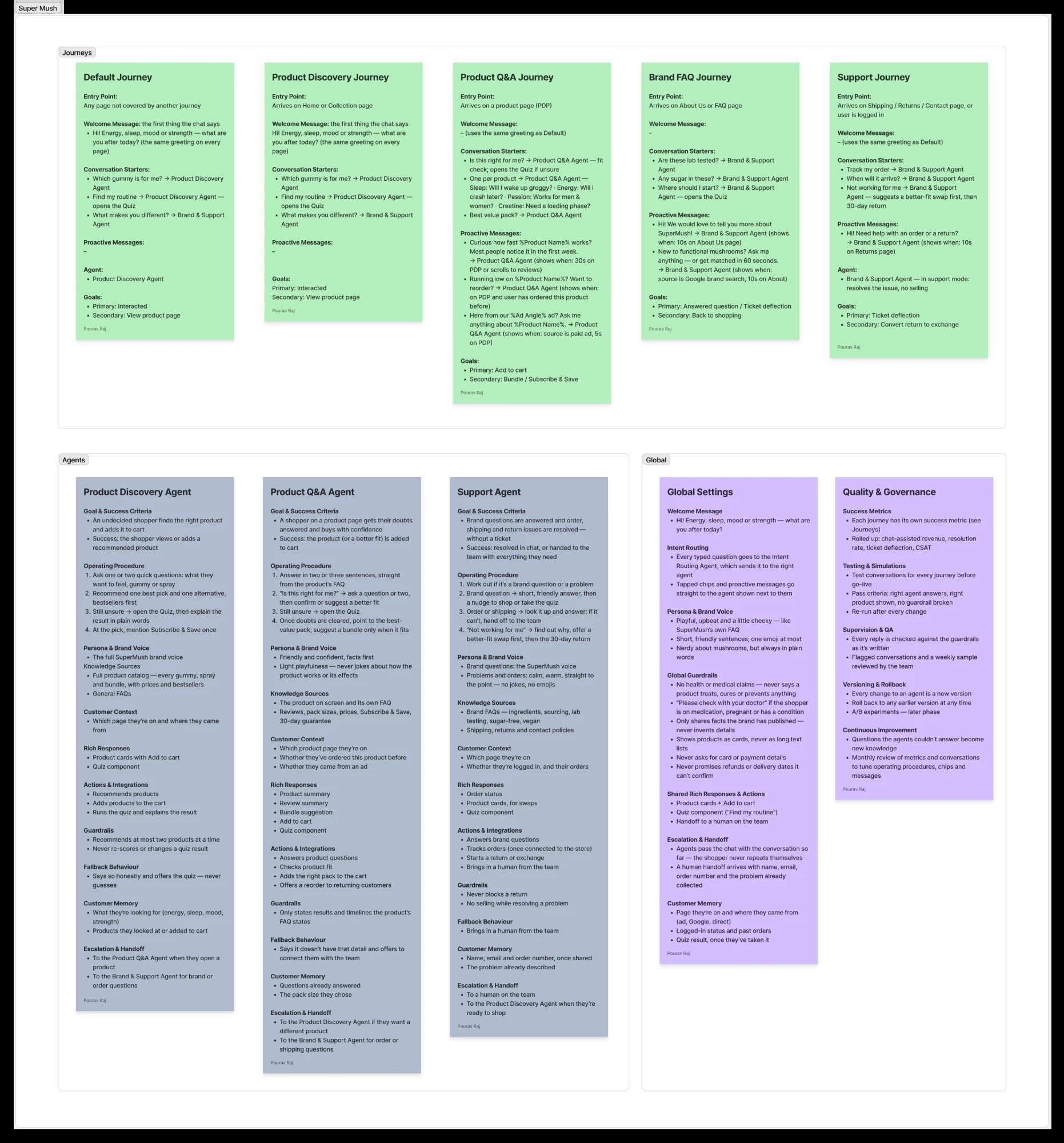
The store's Journeys and Agents, each Journey from entry point to goals
Related
Agents
Who answers inside a Journey.
Global settings
The welcome message, intent routing, and defaults every Journey shares.
Rules
Entry points and “shows when” rules.
Journeys vs campaigns
When the situation is enough and when you need a sequence over time.