

- Journeys answer “where is the shopper, and what do we offer them?” Each Journey has an entry point, starters, proactive messages, an Agent, and goals.
- Agents answer “who talks, and how?” Each Agent has one job, its own knowledge, its own guardrails, and clear handoffs.
- Global settings answer “what is true everywhere?” The welcome message, intent routing, the brand voice, and the rules no Agent may break live here once.
The map
The diagram shows the whole setup. Global settings sit above everything. Each Journey points to the Agent that handles it. The dashed lines are handoffs, where one Agent passes the conversation to another or to a person on your team.The Journeys
Every Journey has the same six parts: an entry point, a welcome message, conversation starters, proactive messages, an Agent, and goals. The table sums up all five.
Three things are worth noticing before you read the details.
- The welcome message is the same everywhere. It lives in global settings, so every Journey shows the same greeting. A Journey tailors what comes after the greeting: its starters and its proactive messages.
- A starter can go to a different Agent than its Journey’s. In the Default Journey, What makes you different? goes straight to the Brand and Support Agent. Each starter and each proactive message names its own Agent. Questions the shopper types go through intent routing instead.
- Default and Product Discovery start out identical. They differ only in entry point. Giving Home and Collection pages their own Journey lets you change them later without changing every other page.
Default Journey
Product Discovery Journey
Product Q&A Journey
%Product Name% fills in the product on screen. %Ad Angle% fills in the angle of the ad the shopper clicked.
Brand FAQ Journey
Support Journey
The Agents
Every Agent has the same eleven parts. Each part has its own page under Agents: goal and operating procedure, persona and brand voice, knowledge and context, rich responses and actions, guardrails and fallback, customer memory, and escalation and handoff. Each Agent adds to global settings. It never overrides them. The global guardrails, for example, apply to all three Agents on top of their own.Product Discovery Agent
Handles shoppers who have not picked a product yet.Product Q&A Agent
Handles shoppers on a product page who have doubts about that product.Brand and Support Agent
Handles brand questions and every order, shipping, and return problem.Global settings
Global settings hold what every Journey and every Agent shares. The welcome message is set here once. Intent routing sends every typed question to the right Agent, while tapped starters and proactive messages go straight to the Agent named next to them. The global voice and guardrails apply to every reply, and the escalation rules make sure a shopper never repeats themselves. Read Global settings.Quality and governance
Quality and governance is how you know the setup works and keep it working. Each Journey has its own goal, and those roll up into storefront-wide metrics. You test every Journey before it goes live, check every reply against the guardrails, keep every change as a version you can roll back, and turn unanswered questions into new knowledge. Read Quality and governance.A shopper’s path through it
Follow one shopper who clicks a paid ad for the Sleep gummy.- The entry point picks the Journey. The shopper lands on the Sleep gummy’s product page from a paid ad. A product page is the Product Q&A Journey’s entry point, and it is more specific than the Default Journey’s, so the shopper is in Product Q&A. The widget shows the global greeting and the Journey’s three starters: Is this right for me?, Will I wake up groggy?, and Best value pack?
- A proactive message greets the ad arrival. After 5 seconds on the page, the ad message’s “shows when” rule matches. A bubble reads “Here from our better-sleep ad? Ask me anything about Sleep.” with
%Ad Angle%and%Product Name%filled in. - The Product Q&A Agent answers from the FAQ. The shopper taps the message and asks whether they will wake up groggy. The message routes straight to the Product Q&A Agent. It answers in two or three sentences from the Sleep gummy’s own FAQ, and it states only the results and timelines that FAQ states.
- The Quiz settles the doubt. The shopper is still unsure the gummy is right for them. Following its operating procedure, the Agent asks a question or two and then opens the Quiz. The quiz result lands in customer memory. The Agent confirms the fit, points to the best-value pack, and shows it as a product card with Add to cart.
- A shipping question hands off with context. The shopper types “How fast do you ship?” Intent routing sends it to the Brand and Support Agent, which is the Product Q&A Agent’s handoff for shipping questions. The conversation so far comes with it, so the shopper does not repeat anything. The Agent answers from the shipping policy and promises no delivery date it cannot confirm.
- The goal is reached. The shopper taps Add to cart on the pack card from step 4. They are still in the Product Q&A Journey, so this counts toward its primary goal, add to cart. Had they chosen Subscribe & Save, it would also count toward the secondary goal. The conversation rolls up into chat-assisted revenue.
The board
The product owner planned this setup on a board before building it in Crossword. It shows the five Journeys, the three Agents, and the global settings described above.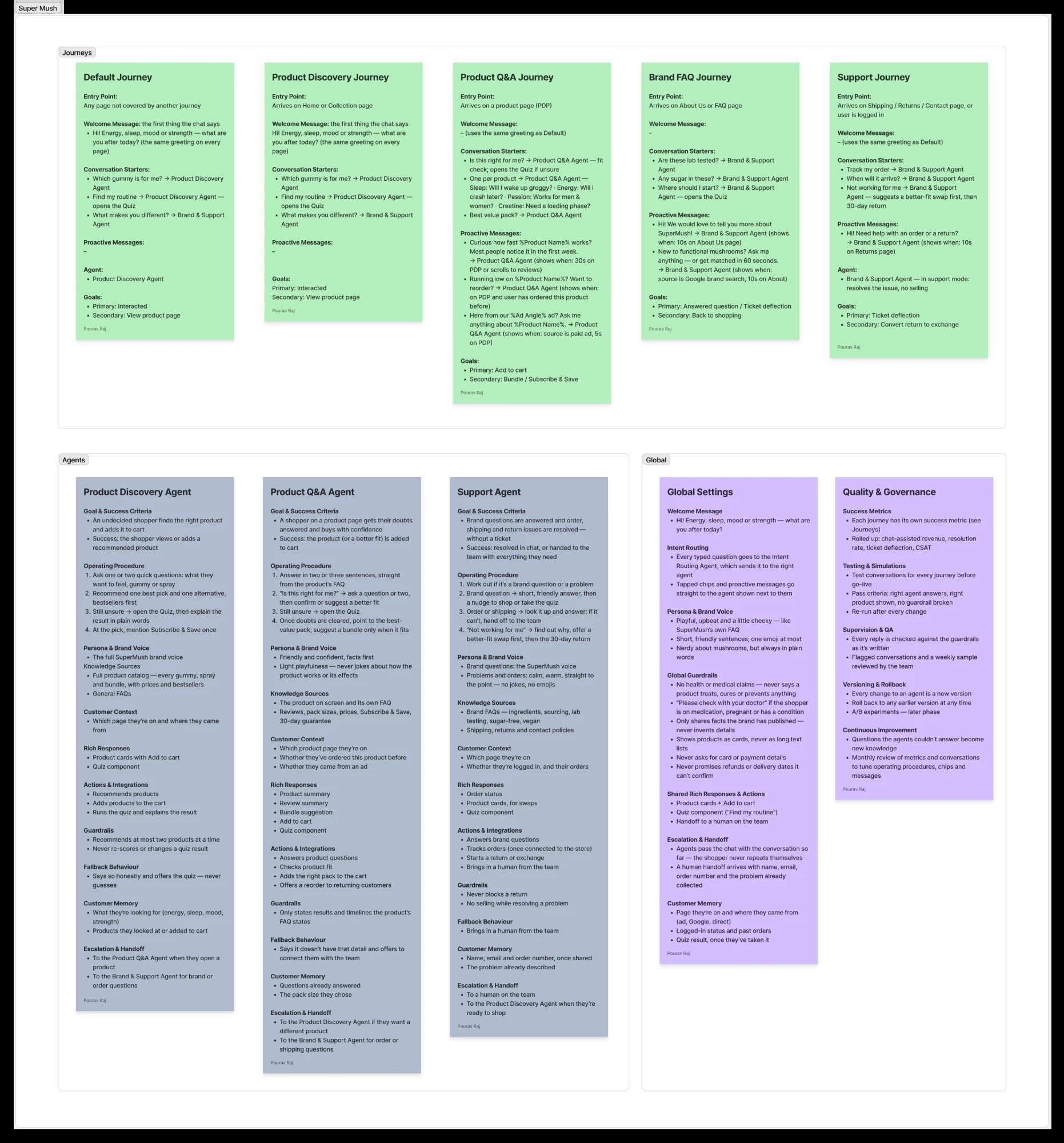
The planning board behind this setup